

Every “how often should you post” article answers with a number. Three times a week. Once a day. Five Reels minimum. The number is always confident, usually unsourced, and almost always wrong for the person asking, because it ignores the only variable that decides the answer: what you can keep making without the quality dropping.
The 2026 data is unusually helpful here, because for the first time in years the median is moving in the opposite direction to the advice. Posting frequency on Instagram has started to come down, while the accounts that win on engagement aren’t the ones posting most.
This is a post about cadence: what the data actually shows, why volume stopped being a lever, and how to set a schedule you can hold for a year rather than a fortnight.
Key Takeaways
- Median posting frequency on Instagram fell slightly in 2025 – the first decline in three years.
- Observed output per format is 8 Reels, 7 single images and 5 carousels a month, and the mix is shifting rather than growing.
- Reels posting volume rose 33% year over year, while the format stopped guaranteeing extra reach. Volume stopped being a lever.
- The winner on engagement in Rival IQ’s data posted below the median frequency – evidence that more isn’t automatically better.
- Set a floor you can hold and a stretch you can reach, and judge both on quality, not on the calendar.
What brands actually post
Start with observed behavior rather than advice, because the two have diverged. Across Socialinsider’s dataset, the average brand posted this many times a month in 2025.
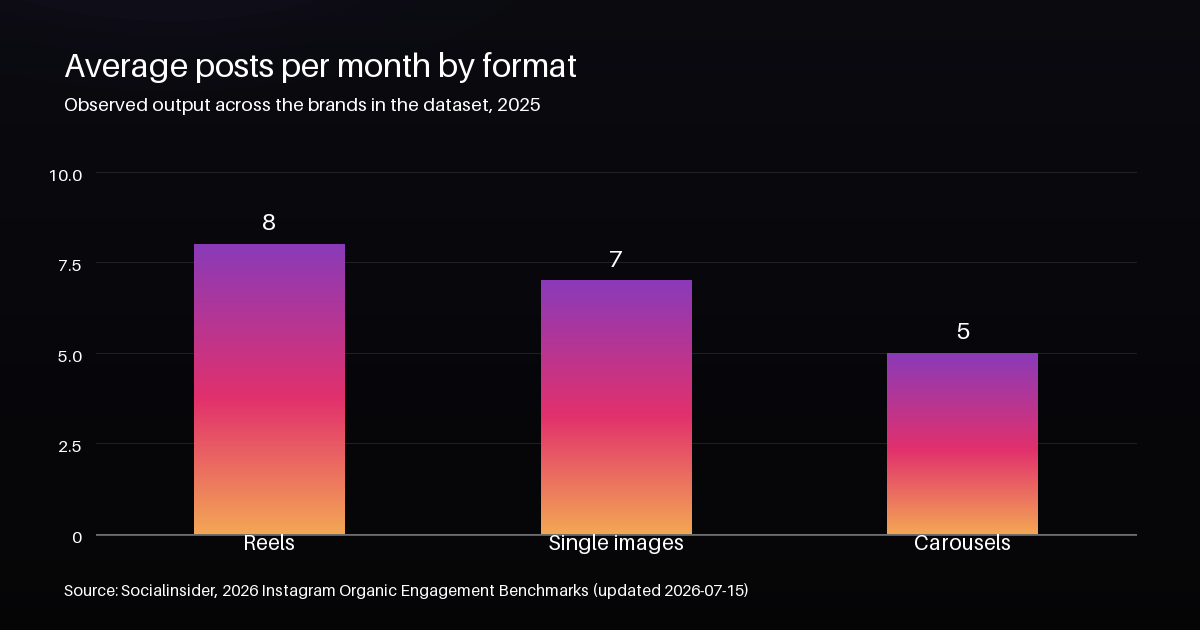
Posting frequency is output per unit of time – posts a week, or posts a month. It says nothing about quality, and it’s the number most people quote as if it did. Four categories, roughly twenty posts a month, which works out at about five a week when you ignore Stories entirely.
That’s the median, not a target. Half of the brands in the dataset post less than that, and some of them are growing faster than the ones above it.
Where the volume actually moved
The more useful question than “how much” is “where”. Comparing 2024 with 2025 shows a reallocation rather than an increase.
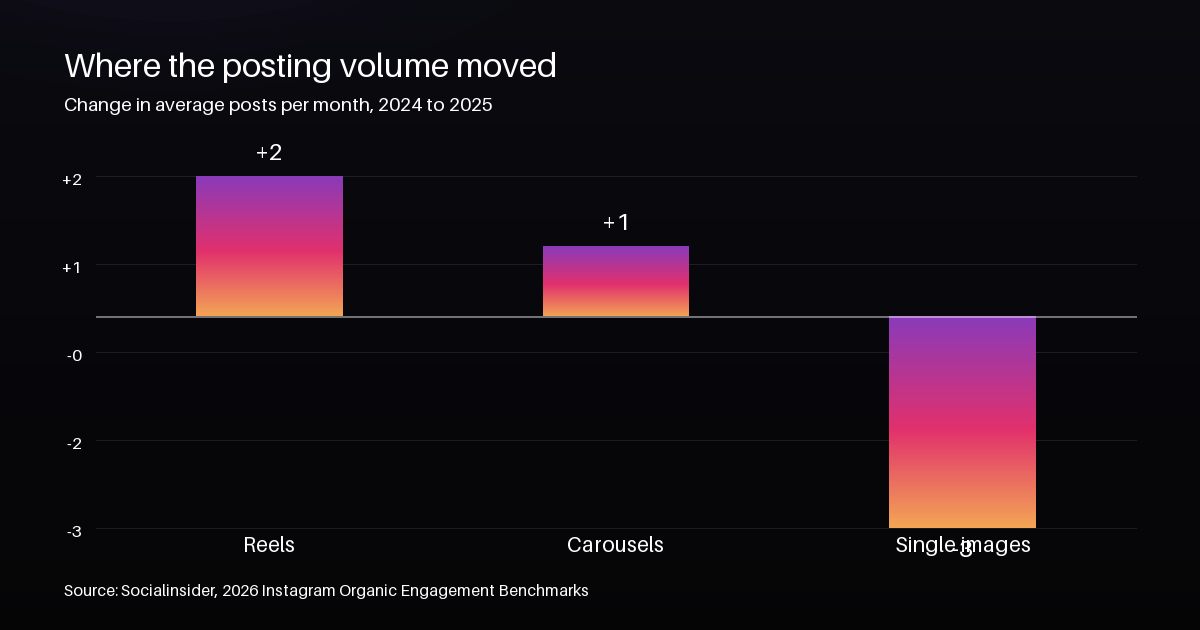
Single images lost three posts a month while Reels gained two and carousels gained one. Total output barely moved. That’s the shape of a reallocation: brands didn’t decide to post more, they decided to post less of the format that was declining and more of the two that weren’t.
Reels volume grew 33% year over year on its own. It’s worth holding that next to the format’s performance, because the contrast is the whole argument of this post: the supply of Reels rose sharply, and Reels stopped guaranteeing incremental reach over the same period. Posting more of the most-produced format is not a growth strategy when everyone is doing the same thing.
Why “more” stopped being a lever
Rival IQ’s benchmark report found something that should be pinned above every content calendar: the clear engagement winner on Instagram was an industry posting below the median frequency. Their own reading of it is blunt – more isn’t always better.
The same pattern shows up at the platform level. Posting frequency fell slightly for the first time in three years, while engagement fell too. If volume were the lever, one of those lines would point the other way.
Socialinsider’s summary of 2025 says it directly: success now depends on strategic format choices and content quality, not volume or scale. And their frequency section makes a distinction that most schedules ignore – consistency matters, but the mix of what you post matters just as much as how often you show up.
Frequency is not consistency
Most schedules conflate these, and the confusion causes the failure.
- Frequency is how many posts you publish in a period.
- Consistency is how predictable the gaps between them are.
An account posting twice a week on the same two days is more consistent than one publishing five posts in a burst and then disappearing for ten days. The second account will tell you it posts a lot. The first account will outperform it, because the audience can predict it.
And bursts are how cadences die. A schedule you can hold for two weeks and not three is not a cadence, it’s a sprint that ends in silence – which is worse for the account than a lower number held steadily.
How to find your own cadence
The honest method has three numbers, and only one of them comes from the data.
Your floor
What can you produce at your current standard in your worst normal week – not your best? That’s your floor. It should be low enough that you’d hit it during a busy month, because the floor is the promise you’re actually keeping.
Your target
Your floor plus the format that overperforms for you. This is where the data earns its place: run a free analysis on your own profile, find the one format beating your average on engagement, and add one of those a week before adding anything else. We covered how to read that comparison per format in the formats guide.
Your stretch
The number you’d hit in a good month with material already banked. Stretch weeks should be filled from a buffer, not from scratch. If a stretch week requires new production, it isn’t a stretch – it’s an overspend that the following week pays for.
A worked example, using the observed averages as the starting point: twelve to sixteen posts a month is the floor-plus-target zone for most small teams, spread across Reels and carousels, with single images for the grid rather than the calendar. That’s below the ~20 a month the average brand publishes, and if your quality holds, it will beat the average brand’s results.
Two rules make the cadence survivable. First, keep Stories out of the count – they’re the relationship layer, and treating them as content production is what makes schedules collapse. Second, review the cadence monthly against your own engagement and reach per format, not against anyone else’s posting frequency. If you want to know how someone else’s rhythm compares, that’s a different exercise: this is how to analyze a competitor’s account.
Five mistakes with posting schedules
1. Copying a frequency from a bigger account
A team of five can hold a daily cadence. One person with a job cannot, and shouldn’t try. Frequency recommendations are capacity statements in disguise.
2. Raising volume before improving the mix
If your format mix is off, posting more of it makes the problem bigger. Fix the mix first, then the volume – it’s cheaper and it works faster.
3. Treating a missed post as a broken schedule
The schedule isn’t broken. Progress is measured over months, and one gap changes nothing as long as the gaps stay predictable in general.
4. Measuring cadence by output instead of by result
Posts per week is an input metric. Engagement rate and reach rate per format are the outputs. A calendar review that never looks at the outputs is theatre.
5. Letting Stories set the tone
Daily Stories create the feeling of daily posting without the production cost, and that feeling is why the content calendar quietly stops being maintained. Count the posts, not the taps.
Frequently asked questions
How many times a week should I post on Instagram?
There’s no single correct number, and the 2026 data argues against picking one from a list. The average brand publishes about twenty posts a month across formats, but the strongest engagement result in the benchmark data came from an industry posting below the median. Start from what you can sustain at your standard.
Is posting every day bad?
Not inherently – it’s bad only if the quality drops or the schedule collapses. Daily posting is a capacity claim, so it’s the right choice when a second person or a system is producing some of it.
Do I need to post Reels every day?
No, and Reels volume rising 33% year over year while the format stopped guaranteeing reach is the reason to be cautious. Post the number of Reels you can make well enough that someone would send one to a friend.
Does posting less hurt my reach?
Less output with a better mix usually beats more output with a worse one in the current data. What hurts is unpredictability, so protect the gaps rather than the count.
How do I know if my cadence is working?
Watch engagement rate and reach rate per format over a thirty or ninety day window, not the number of posts. The analysis covers both metrics per format, and the free preview is enough to see the trend. If the rates move up while the count stays flat, the cadence is working.
The short version
Posting frequency is a capacity question, not a growth lever. Median frequency is falling, Reels volume is up without a matching return, and the engagement winner in the benchmark data was posting below the median. Set a floor you can hold, add the one format that overperforms for you, and judge the whole thing on rates rather than on the calendar.
Run a free analysis on your own profile to see which format is carrying your engagement before you decide how often to post it. If you want the deeper read on positioning and content strategy, start with the numbers and work outward from there.